

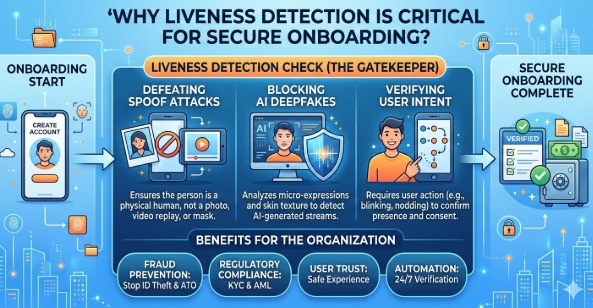
In today’s digital world, online services bring convenience but also security challenges. From banking to healthcare, organizations increasingly rely on remote identity verification to onboard users safely. One key technology enabling secure onboarding is liveness detection. It ensures the person interacting with a system is physically present, preventing fraud attempts using photos, videos, or AI-generated deepfakes.
Understanding liveness detection and its role in secure onboarding is essential for businesses aiming to reduce fraud, comply with regulations, and provide a trustworthy digital experience.
What Is Liveness Detection?
Liveness detection is a biometric security technique that confirms an individual is alive and present during authentication. Traditional face recognition can be deceived by photographs, videos, or masks. Face liveness detection overcomes these vulnerabilities by analyzing subtle physiological cues, behavioral patterns, or device interactions in real time.
There are two main approaches: active liveness checks, which prompt users to perform actions such as blinking or turning their heads, and passive liveness, which evaluates natural behaviors without any user input. Both methods enhance the security of onboarding processes.
Why It Matters in Onboarding
Preventing fraud is one of the most important benefits. Cybercriminals can manipulate images or create deepfakes to impersonate legitimate users. Integrating liveness detection for face recognition ensures only live, present individuals can complete verification, significantly reducing identity fraud.
Compliance with regulatory standards such as KYC (Know Your Customer) and AML (Anti-Money Laundering) is another reason liveness detection is critical. Organizations must verify users reliably, and liveness checks help demonstrate adherence to these regulations.
Additionally, secure onboarding builds user trust. Passive liveness methods provide a frictionless experience while confirming genuine identity, increasing customer confidence in digital services.
How Liveness Detection Works
Modern liveness detection uses multiple layers of analysis. AI-based algorithms can detect subtle micro-expressions, eye movements, skin texture, and depth to distinguish real human faces from images or synthetic content. This approach protects against spoofing attacks, including deepfakes, 3D masks, and video replays.
Face liveness detection can operate on smartphones, tablets, or desktop systems, making it versatile for digital onboarding. The integration of passive liveness ensures users can complete verification seamlessly without complex actions, balancing security with convenience.
Applications Across Industries
Liveness detection is widely adopted in sectors where secure identity verification is essential. In financial services, it prevents account takeovers and ensures regulatory compliance. Healthcare providers use it for patient registration and telemedicine to protect sensitive records. Online gaming platforms rely on it for age verification and account security, while e-commerce platforms integrate it to secure high-value transactions.
Across these applications, liveness detection for face recognition strengthens trust and safeguards both businesses and their users against emerging threats.
Challenges and Considerations
Despite its effectiveness, liveness detection faces challenges. Environmental factors like lighting can affect accuracy, and older devices may not support advanced features. Privacy concerns are also critical, as biometric data must be securely handled in compliance with regulations. Regular updates and AI model training are required to minimize false positives or negatives and ensure reliability.
The Future of Liveness Detection
The demand for secure digital onboarding is growing. Future systems are expected to integrate multimodal biometrics, advanced AI to detect deepfakes, and privacy-preserving methods to protect users’ data. By adopting these advancements, organizations can create safer onboarding experiences while staying ahead of increasingly sophisticated fraud attempts.
Conclusion
Liveness detection plays a pivotal role in digital onboarding, verifying that the person interacting with a system is real and present. Techniques like passive liveness, liveness check, and face liveness detection help prevent fraud, support regulatory compliance, and enhance user trust. As identity fraud evolves, integrating liveness detection for face recognition ensures that organizations can provide secure, efficient, and reliable onboarding experiences for their users.